
I recently had the opportunity to work on a case study for a job interview (for a running shoes brand). The main goal of the case study was formulated this way:
Your mission: Double our e-commerce traffic and revenue in the next 12 months, while keeping discount periods exactly as they are today.
While working on this exercise, I found it extremely useful to document the considerations, assumptions, and logic I applied during the process. And guess what? Writing things down while I was working on the exercise helped me step back, slow down, and approach the problem in a more structured and effective way. I hope this article can help other professionals who are facing a similar business challenge — whether for a job interview, an internal strategy review, or a real-life growth plan. And maybe, just maybe, it can also help you land your next job.
Phase 1: Data analysis and estimation
Before creating any presentation or jumping into solutions, I started by analysing the scenario and gathering as much data as possible. The goal here is not to be perfect, but to be directionally right.
Understand the business size
Start with some generic online research to understand the overall business dimension in terms of sales. Useful searches can be:
- “Brand XYZ annual turnover”
- “Brand XYZ annual sales”
- “Brand XYZ funding / news”
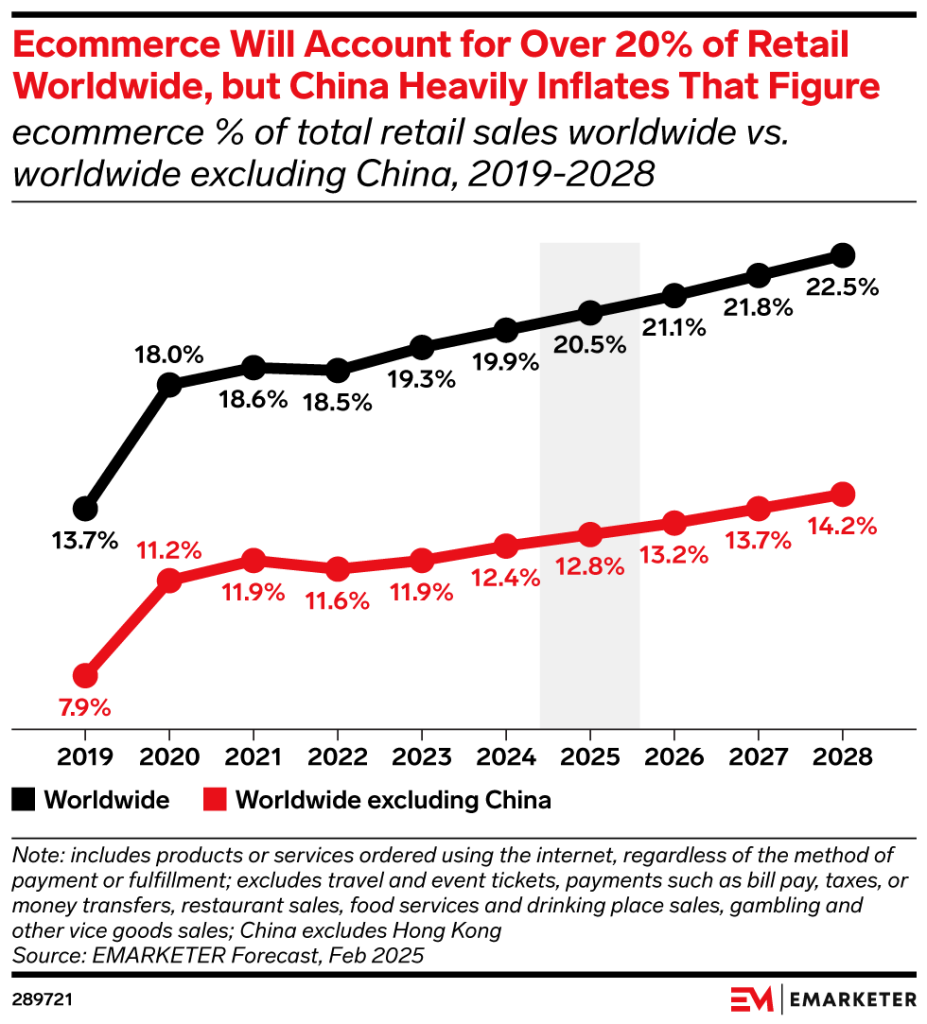
Even better if you can speak with someone in the industry. Having a rough ballpark number helps you reason about the current situation. Is this brand doing €5 million, €50 million, or €500 million per year? The strategic implications are completely different. Once you have an estimate of total revenue, try to understand how much the e-commerce channel contributes to the overall business. In my case, it was a running shoe brand, and in this industry it’s quite common for DTC e-commerce to represent around 10% of total sales. According to eMarketer data (see screenshot below), the worldwide average in 2025 is around 12.8%.
Tip: if you can’t find exact numbers for the brand, try to estimate them by comparing with similar competitors — brands with a comparable market positioning, heritage, or number of physical stores. This first step already helps you frame the challenge: doubling e-commerce revenue could mean very different absolute numbers depending on the starting point.
Estimate DTC traffic and digital sales
The second step is to estimate the traffic to the brand’s DTC website. I used three tools:
- Semrush
- Similarweb
- Ahrefs
These tools are not always accurate, especially for smaller brands, but they provide a useful range. A rough idea of website traffic allows you to estimate digital sales when combined with realistic conversion rates and average order value. Other questions worth asking (or researching):
- Is the brand relatively new or well established?
- Are there recent interviews, press releases, or strategy statements online?
- Has the management team shared insights about product strategy, geographic focus, or brand marketing?
For example, during my research I found an interview where a brand manager shared insights about their product launch strategy and market prioritisation. These qualitative inputs are incredibly valuable when numbers are limited. With all this information, you can build a range estimation of annual recurring revenue and monthly traffic for the DTC channel — focusing only on the brand’s e-commerce, and excluding other revenue streams such as marketplaces or Amazon. This phase is less about precision and more about showing your ability to reason with incomplete information, which is a very real-world skill.
Phase 2: Overall strategy (C-level oriented)
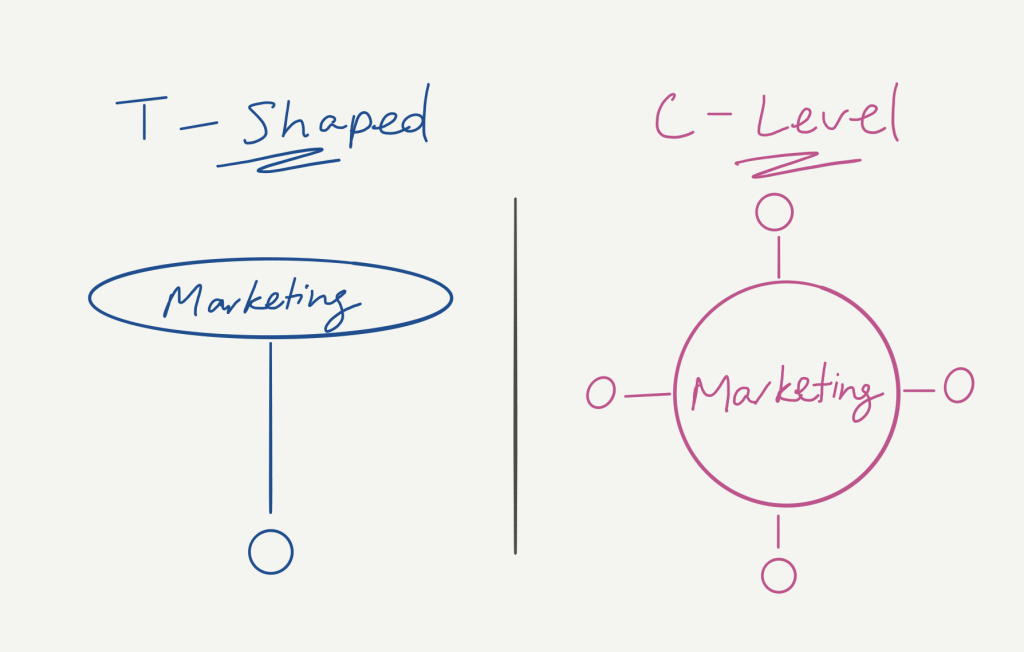
I’m a technical and detail-oriented professional by nature. Over the years, working both in large corporations and in SMEs, I learned a key lesson: the higher the role you’re applying for, the higher the altitude of the conversation needs to be.
A common mistake in case study preparation is to dive too quickly into tactics, tools, and one-off ideas. Another frequent pitfall is over-explaining technical details behind specific decisions. Instead, at this stage, you should keep the conversation strategic and high-level. Even if the hiring manager is not a C-level executive, you want to demonstrate that you are capable of thinking and communicating like one. This signals accountability — one of the most important traits companies look for when hiring senior profiles. It shows that you can take ownership of what will eventually be your desk. (Side note: this short and insightful article helped me a lot in framing my approach — worth a read.)
Define objectives and key levers
Start by clearly defining: What are the strategic objectives? What are the key levers to prioritise? In this specific case, the objective was crystal clear: double e-commerce revenue and traffic in 12 months. Now, think big and be honest with the numbers. Doubling revenue means selling almost twice the number of products compared to the current year (assuming stable prices and no additional discounts). Ask yourself:
- Is the company launching enough new products every year?
- Is production and stock capacity aligned with such growth?
- What happens operationally if demand grows faster than supply?
On the traffic side, doubling visits in one year cannot realistically rely only on long-term initiatives like SEO or brand building. Those are fundamental, but they rarely deliver exponential results in such a short time frame. For this reason, short- to mid-term levers such as CRM (email & lifecycle marketing) and paid advertising often become central in this type of challenge. The strategy needs to be both ambitious and credible. In my case, I focused on three main growth drivers: new products, new leads for the CRM, new audiences to reach.
Limiting the strategy to 2–3 core pillars helps keep the story clear, focused, and convincing.
Phase 3: details, tactics, and presentation
Once the main strategy is defined, it’s time to go deeper into execution. Ideas are a good qualifier, but execution is what really matters. This is the phase where you show that you are not just a strategist, but someone who can actually make things happen.
Execution plan and timeline
Describe all the steps required to execute the strategy and achieve the result. A clear execution timeline is always appreciated, because it:
- Shows your project management skills
- Demonstrates that you understand sequencing and dependencies
- Makes the strategy feel tangible and realistic
Even a high-level roadmap with quarterly milestones can make a big difference.
Risks and mitigation
Another key section of my presentation was risk and mitigation. Show that you understand what could go wrong and how you would react if the plan deviates from expectations. The types of risks you highlight say a lot about your level of business understanding. If you only focus on small operational details, you might be missing the bigger picture — such as:
- Macroeconomic scenarios
- Market-wide discount pressure
- Supply chain constraints
- Paid media cost inflation
Addressing these topics reassures the interviewer that you can manage complexity and uncertainty.
Presentation best practices
Keep the presentation short and effective: 5 to 10 slides max. In most corporate environments, you’ll have limited time to present. Focus on clarity and relevance. All the extra details are valuable, but they can be discussed live or in follow-up conversations. A few practical tips (based on mistakes I’ve already made): send the presentation in PDF format (avoid .PPT or software-dependent files); export a lightweight version (no heavy images or unnecessary animations); assume it will be opened on different devices. These may sound like basic suggestions, but they can genuinely improve the overall impression.
Case Study download
You can download the full Case Study using the link below. It’s completely free, and I genuinely hope it can help you prepare for your next interview or business challenge.
I removed all references to the running brand for privacy reasons.
If you have any questions or need help, feel free to reach out. I’m always happy to help other professionals find their way and land new opportunities.
Side notes, credits, sources
Images: eMarketer, Howtosaas, Runners World.