
“We’re not on Amazon, and we don’t need to be.” I hear this sentence often from brand managers and owners. Most of the time it isn’t true: their products are on Amazon, sold by someone else. What they mean is that they don’t sell there directly. I had the opportunity to lead a marketplace project for an Italian textile company managing several home-textile brands. The goal was clear: open new direct-to-consumer channels across European marketplaces. I expected the first weeks to be about listings, pricing and logistics. Instead, the critical path was something more basic: proving that the company owned its own brands on Amazon.
This article shares what I learned. Why Amazon Brand Registry matters even if you don’t sell on Amazon, what you need to enrol, how third-party sellers fit in, and why the most important question is not “are we registered?” but “who owns the account?”. The case comes from textiles, but the same lessons apply to any sportswear, outdoor or consumer brand distributed through retailers and wholesalers. I’m sharing my direct experience in the hope that it helps other managers handle this channel.
Your brand is already on Amazon (whether you sell there or not)
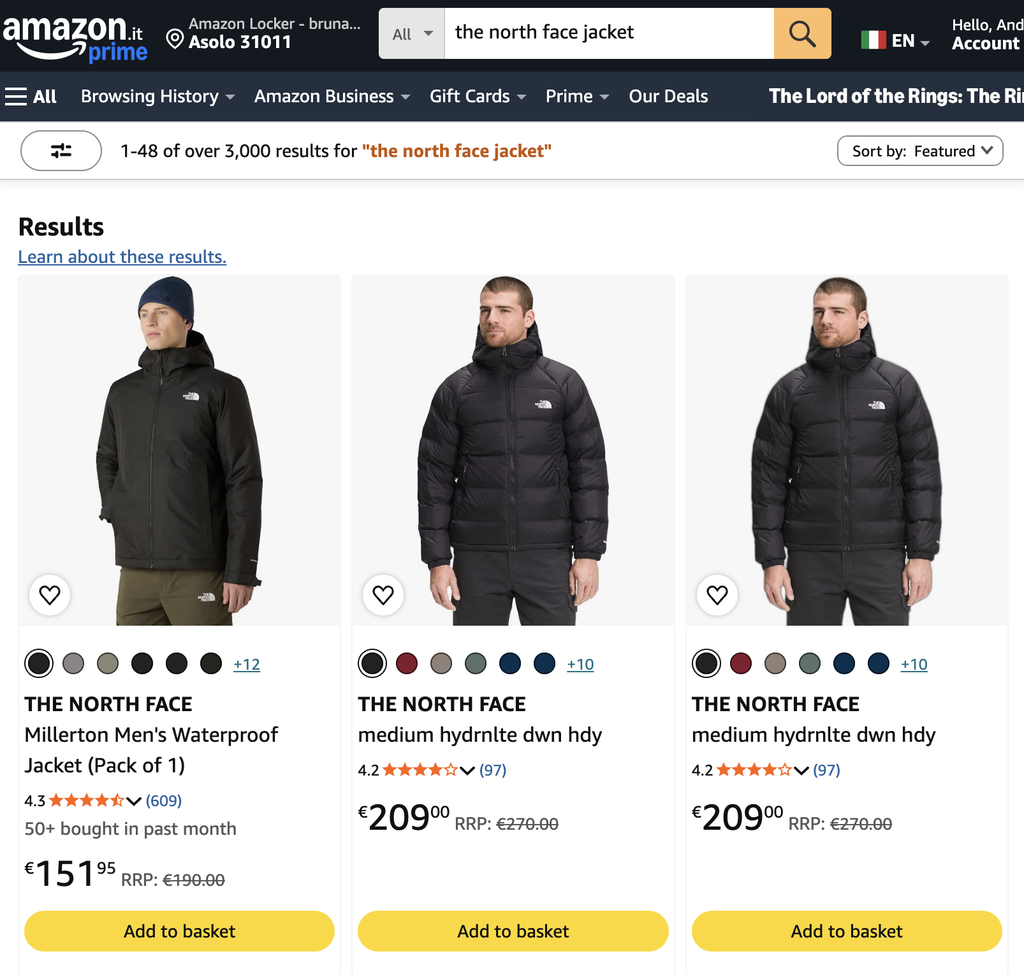
Amazon works with two main models. In the 1P model (Vendor Central), you sell to Amazon as a wholesale customer, and Amazon sells to the end consumer. I covered it in detail in this article on Amazon Vendor Central. In the 3P model (Seller Central), independent businesses (or the brand owner itself) sell directly to consumers on the marketplace. These are the third-party sellers. A third-party seller can be anyone who legitimately bought your products: a retailer, a distributor, a wholesaler’s customer, an outlet clearing old stock. They can match an existing product page or, in many cases, create a new one. Titles, images, descriptions and prices are then shaped by whoever got there first. Many of the brands and clients I have worked with were in this second situation: their Amazon business was managed by a third-party seller.
Is it the best choice? It can be, depending on your brand’s situation. But if no one inside your company has a voice on Amazon, your brand presence is written by others. Inaccurate product pages, old images, wrong sizes and online retail’s worst nightmare, aggressive discounting: all of this reaches the end customer under your name. In our project, we discovered this the hard way. A sales partner was ready to list the company’s products on Amazon, but got blocked immediately: one of the brands had already been registered in Brand Registry, and not by an account the company controlled. Not the best starting point for a new channel.
What Amazon Brand Registry is (and why you can enrol without selling)
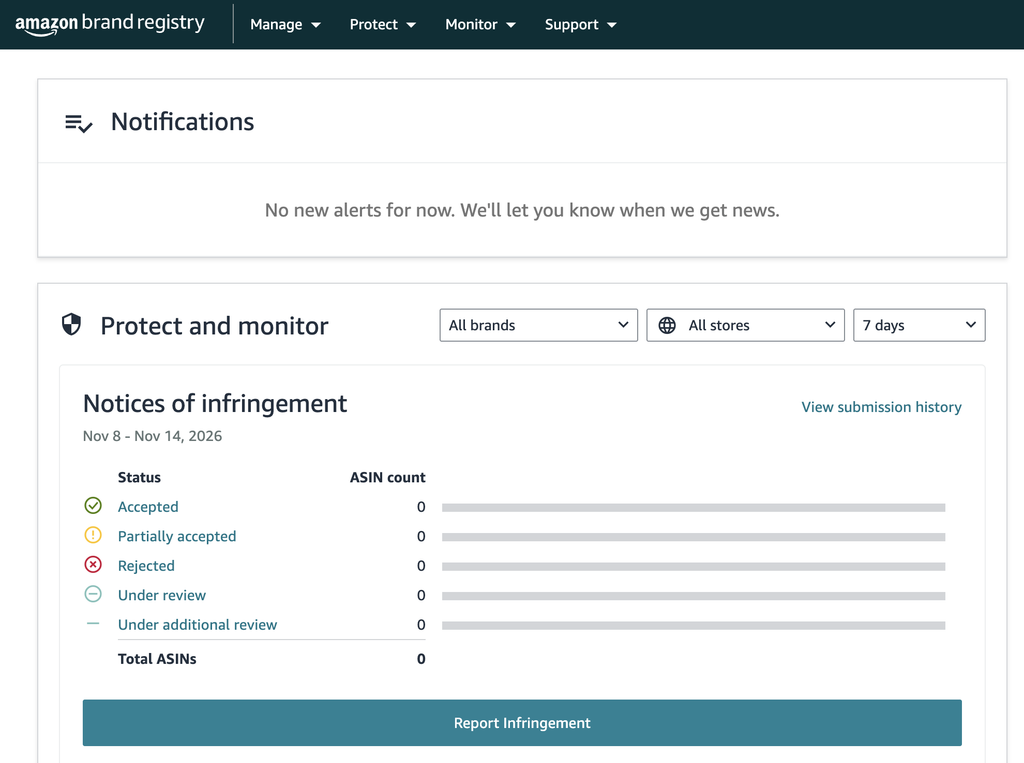
Amazon Brand Registry is a free programme for trademark owners. Amazon itself states that it helps you protect your intellectual property, manage your listings and grow your business regardless of whether or not you sell on Amazon (Amazon Brand Registry, Italy). This is the point most brands miss. You don’t need a selling account to enrol. Without one, you won’t access selling tools like A+ Content and Brand Stores, but you can still use protection tools such as Report a Violation from the Brand Registry portal (Amazon Selling Partner Blog). Once enrolled, the main benefits fall into two groups.
Protection:
- Report suspected IP infringements and counterfeits.
- More weight on the accuracy of product information for your brand.
- Advanced tools like Transparency and Project Zero, for brands with counterfeit issues.
Growth (with a selling account):
- A+ Content and Brand Store to tell your brand story (see also the value of lifestyle images on your product pages).
- Sponsored Brands ads and Brand Analytics data.
- Control over which partners can sell and edit content under your brand.
In other words: Brand Registry is not a sales tool. It is the legal and operational proof that the brand is yours inside the largest marketplace in Europe.
Who owns your Brand Registry account (and how to recover access)
Amazon’s rule should be simple: only the trademark owner can enrol a brand. If you are an authorised agent, the owner must enrol the brand first and then add you as an additional user (Amazon Brand Registry, Italy). In theory, this protects brands. In practice, many companies enrolled years ago in a hurry, through whoever was available at the time. Often, employees simply followed “expert” advice, usually from an external agency with years of experience. “Let us register the brand for you” and “we’ll take care of all the steps” are the sentences that make companies hand the steering wheel to external partners. When I mapped the situation across the company’s brands, I found three different stories.
- Case 1: the forgotten account. An old Brand Registry account had been opened with a generic IT mailbox. It was almost empty, with only one minor trademark. Nobody remembered who had created it or why. A relic from the past.
- Case 2: the agency that disappeared. One of the main brands had been enrolled years before by an external agency. The agency no longer answered emails; as it turned out, it was no longer operating in that business. The company owned the trademark, but someone else held the keys.
- Case 3: the wrong country. Another brand had been enrolled using a trademark from a single non-European country, by people no longer involved with the company (in our case, an independent freelancer based in the US). Recovering access took days of detective work just to track down the freelancer’s contact details. Only then could we connect the EU trademark (EUIPO) and cover the European stores.
Amazon has a procedure for this. If the administrator has left the company, you can ask Brand Registry Support to update brand ownership, or apply again with the same trademark number and file an appeal (Amazon Brand Registry, Italy). It works, but it takes time, documents and internal coordination. Time you’d rather spend selling.
The verification email nobody expects
There is one more step that surprised some people in the company. After an application, Amazon sends an email to the trademark correspondent listed on the trademark record. In our case, the correspondent was an external IP law firm, the one that had registered the company’s trademarks. Someone there must click a confirmation link within 7 days; otherwise, the application is declined (Amazon Selling Partner Blog). The email landed in the inbox of a person at the firm who had handled the trademark filings years earlier. Without a heads-up, it would have looked like spam. Tell the trademark contact before you apply.
My rule: the company owns; partners get roles
After these cases, my recommendation is always the same:
- The Brand Registry account belongs to the legal entity that owns the trademark, never to an agency, a distributor or a single employee.
- Use a company role-based email (for example, brand@ or marketplace@), not a personal one.
- Keep at least two internal administrators, so the account survives people changing jobs.
- Agencies, distributors and sellers get roles, not ownership. Amazon assigns the rights owner and administrator roles to whoever enrols, and lets you invite other users with specific roles (Amazon Brand Registry, Italy).
Amazon Brand Registry requirements: the practical checklist
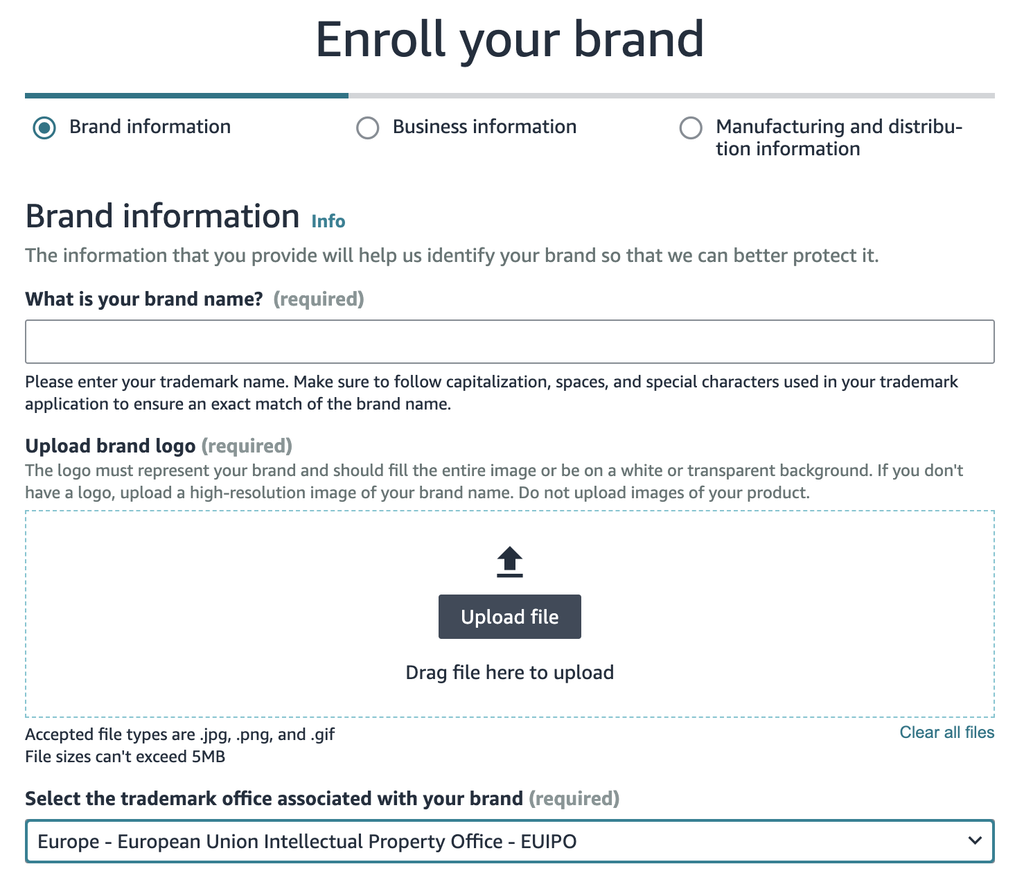
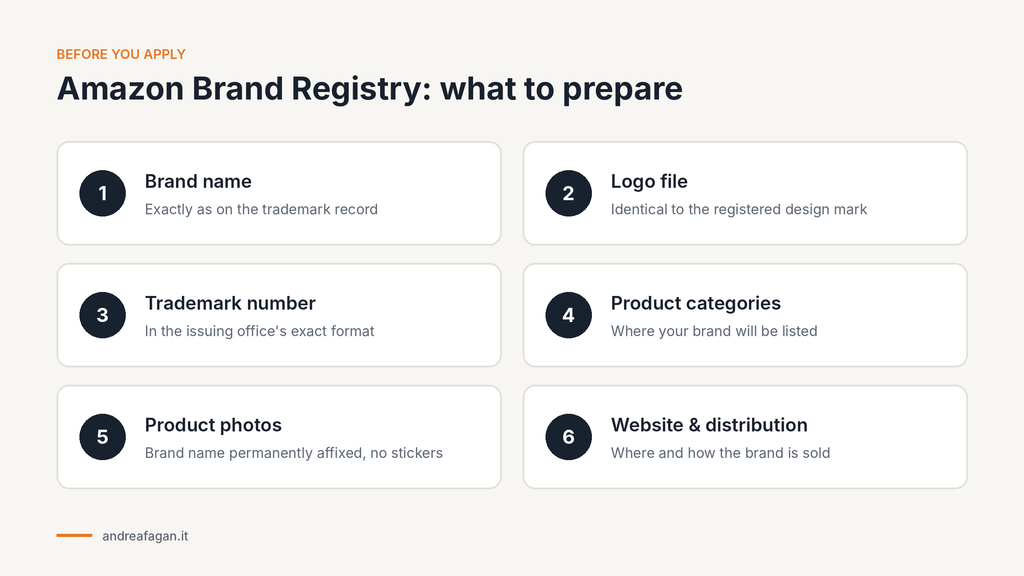
To enrol, your brand needs an active registered trademark or a pending application, either a word mark or a design mark with words, letters or numbers, from an approved government IP office (Amazon Selling Partner Blog). The trademark must come from the office of a country with a corresponding Amazon store. For European brands, an EU trademark usually covers the main EU stores. Before opening the application, collect these materials (Amazon Selling Partner Blog):
- Brand name, written exactly as on the trademark record (spaces and symbols included).
- Logo image, identical to the trademark record, if your mark is a design mark.
- Trademark registration or application number, in the exact format of the issuing office.
- Product categories where your brand should be listed.
- Photos of the product or packaging showing the brand name permanently affixed.
- Website and distribution information, if available.
Common mistakes (we made some of them)
- The wrong logo file. The file we had at hand was a marketing version, with different colours from the one on the trademark record and on the products. Ask for the file used in the trademark filing.
- Nobody knows where the certificates are. Trademark documents often sit with the legal office, an external IP firm or a founder’s email. Find them before you start, not when Amazon asks.
- One account per brand. You don’t need it. Amazon lets you manage multiple brands and add trademarks from other countries to a single global account (Amazon Brand Registry, Italy).
Third-party sellers: from threat to authorised partners
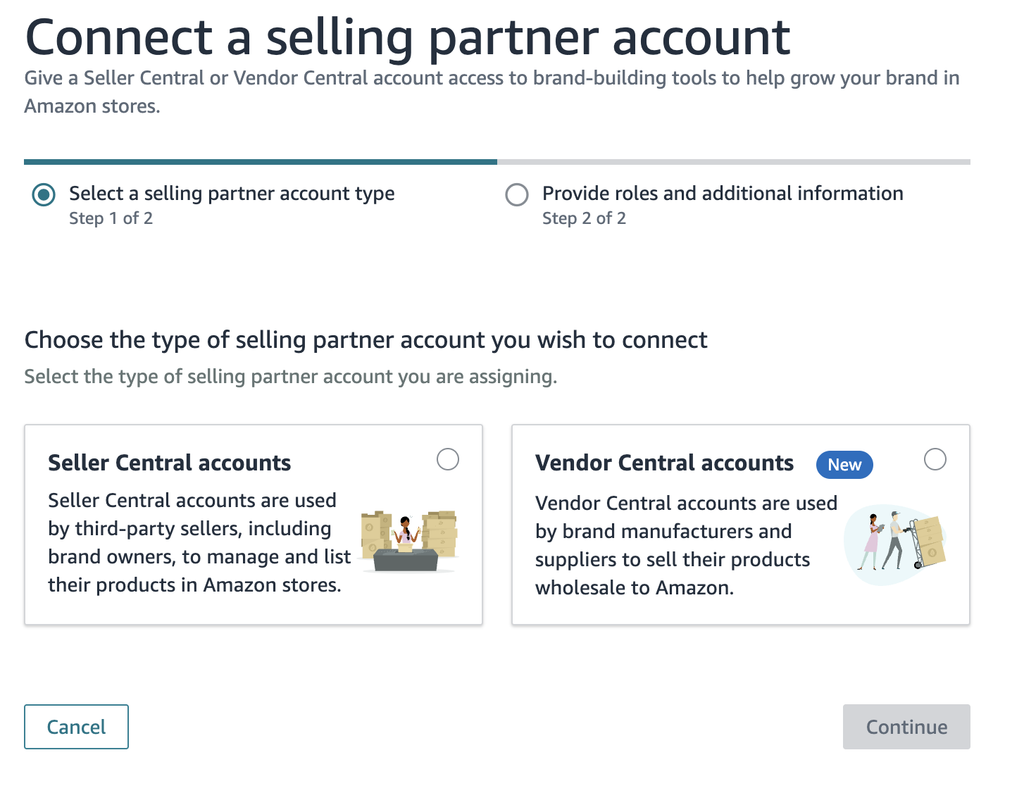
Once the company owns its Brand Registry, third-party sellers stop being only a risk. They can become a distribution choice. In our project, the company decided to work with a specialised marketplace partner selling on its own Amazon account. The partner explained a key detail: if they had requested brand approval through their own seller account, they couldn’t create new listings. The right path was for the brand owner to add them from Brand Registry as an authorised selling partner, with a specific role. Amazon publishes guides to the available protection and selling roles (Amazon Selling Partner Blog).
The partner also asked for a brand representative role rather than a lighter one. Their reason: more weight when opening cases with Amazon and when contributing content to product pages. It is a reasonable request, but it is also real power over your brand. Give it consciously, in writing, and review it.
Two situations to watch
Licensed brands. If you manufacture products under licence, the Brand Registry belongs to the licensor, not to you. Your Amazon plans depend on their approval and on the scope of the licence contract, which may not include marketplaces at all. Check the contract before you build a channel plan.
Partners who want more than they need. Not every wholesaler or reseller who asks for access should get it. For example, a partner selling to Amazon as a vendor could take away your control over pricing, and price erosion on Amazon quickly spreads to your other channels (I wrote about this in 6 proposals to reduce the discount percentage on your brand e-commerce). Decide who joins, and periodically review who still has access.
What I would do tomorrow morning
If you manage a brand and you are not sure about your Amazon situation, this is my suggested plan:
- Search your brands on Amazon, in every store you care about, in Europe or worldwide. Check which products are listed, who sells them and at what price.
- Find your trademark records: office, number, owning entity and the correspondent contact listed on the record.
- Check whether a Brand Registry account already exists. Ask IT, former agencies and long-standing colleagues. If one exists and you can’t access it, start the ownership update procedure.
- Enrol or consolidate all brands under the trademark-owning entity, with a company email and two internal administrators.
- Write a short roles policy: which partners get which role, who approves, and when you review access (every quarter is enough).
None of these steps requires selling on Amazon. All of them keep your options open for when you decide to.
Brand Registry is a strategic decision, not an admin task
It is tempting to see Brand Registry as paperwork for the legal office. In my experience, it is the first gate of any marketplace strategy. Who owns the account decides who controls your product content, which partners can sell your brand, and how fast you can move when an opportunity appears. In our project, sorting out ownership took weeks. Every week was a week the sales channel could not open.
FAQ: Amazon Brand Registry ownership
Yes. Brand Registry is free and open to trademark owners whether or not they sell on Amazon. Without a selling account, you won’t use A+ Content or Brand Stores, but you can still report violations and protect your listings.
You can recover it. If the administrator is no longer reachable, ask Brand Registry Support to update brand ownership, or apply again with the same trademark number and file an appeal. Keep your trademark certificate ready as proof of ownership.
No. The application must come from the trademark owner. The owner enrols the brand and then adds agencies, distributors or sellers as users with specific roles.
The trademark must come from the office of a country with a corresponding Amazon store. One global Brand Registry account can hold trademarks from several offices, and Amazon recommends adding a trademark for each store you want to sell in. For European brands, an EU trademark usually covers the main EU stores.
Seven days. Amazon emails the correspondent listed on the trademark record, and if nobody clicks the confirmation link in time, the application is declined and must be submitted again.
Actions after reading
I work as a Fractional Digital & E-commerce Manager for brands that need senior guidance on DTC and marketplaces without a full-time hire. Brand Registry, channel strategy and partner selection are often the first things we put in order.
If you’d like a quick review of your brand’s position on Amazon and European marketplaces, write to me. Email: andreafagandigital@gmail.com
Side notes, credits, sources
Articles: Amazon Selling Partner Blog, “What are the requirements for enrolling a brand in Amazon Brand Registry?” (August 2025); Amazon Brand Registry, Italy: programme page and FAQ; Amazon Vendor Central (1P): 5 strategic drivers for a sustainable business growth.
Images: screenshots from Brand Registry accounts (anonymised). Cover photo (Cadini di Misurina, Dolomites): Freepik.
Amazon rules were checked in November 2026 and may change: always verify the current requirements in your Brand Registry account.